
Stefan Brandt


Stefan Brandt – when physics meets fabric and luxury suddenly becomes logical
There are brands that tell a beautiful story – and there are brands that prove a hypothesis. Stefan Brandt belongs to the latter category. What began as an almost scientific obsession with raw materials and process quality has become a signature style defined less by logos than by tactile qualities, precise dimensions, and the quiet feeling that "it just works." Textile precision that functions like well-structured sentences: unembellished, substantial, yet poetically fluid. The appeal of this world is not loud. It reveals itself in the case of a jersey shirt, in the feel of a T-shirt, in the way a color still looks as if it were just discovered after the fifth wash.
At the heart of this aesthetic is a founder who initially studied physics and then found his formula in fashion. According to the brand, Dr. Stefan Brandt established his own production facility in Quito, Ecuador – a location predestined for jersey fabric – in 1994 and has since been working on processes that refine cotton from "very good" to "outstanding." Since 2022, the brand has cultivated its own Gossypium barbadense cotton there; a vertically integrated approach that means quality control from field to seam. This isn't folklore, it's strategy.
Stefan Brandt T-shirt
The Stefan Brandt T-shirt isn't just a basic; it's a material statement. The brand works with select bales of Peruvian ELS Pima cotton ("selected Pima") and develops a jersey fabric that feels like silk yet remains 100% cotton. The key lies in a 15-step "prefit" process —a self-contained ritual using water, steam, and heat. This process, which requires no chemical additives, removes pigments and residues from the yarn and gives the fabric natural elasticity and exceptional dimensional stability. In other words, the T-shirt feels softer, drapes more beautifully, fades less, and retains its shape after dozens of wears and washes. According to the brand, it's also suitable for tumble drying , a rarity in this quality category.
Those browsing the product range will encounter model names familiar to connoisseurs: ENNO , ELI , ANTONIO – lines that often appear in two weight variations. Anexo 50 represents a lighter, silky, brightly reflective jersey (around 125 g/m², fitted for men's T-shirts), while Anexo 30 offers a slightly heavier feel (approx. 175 g/m²) without losing its characteristic softness. This difference isn't merely theoretical, but tangible: those who wear T-shirts under shirts often prefer the ultra-lightweight 50; those planning solo appearances opt for the 30 for a bit more body.
The ELI name, for example, offers a range of options, including the "Sea Island" quality from the in-house URPIMA line. An ELI SEA ISLAND I100 is priced at around €179 in the brand's online shop – a price that makes the promise immediately tangible as soon as you roll the fabric between your fingers. Sea Island T-shirts bearing the same design signature are also available in stores, listed in Germany, for instance, at premium retailers. The price range for short-sleeved basics, depending on the quality, is roughly between €139 and €195 in Europe, and sometimes higher internationally – a realistic benchmark for those who prioritize material quality over logo worship.
Quality is evident not only in the yarn but also in the manufacturing process . Brandt employs unusually artisanal techniques in its jersey fabrics: collars, cuffs, and plackets are hand-stitched before sewing , and intricate seams are guided using templates. The mother-of-pearl buttons (on shirts and polos) are sewn on crosswise and with a shank ; according to the brand, the button won't tear off—the fabric will stretch rather than break. Precision is achieved not by chance but through a systematic approach: measurements taken during sewing ensure tolerances of ± 1 mm . For T-shirts, this means hems, necklines, and shoulders—everything fits perfectly, yet remains elastic enough to drape elegantly over the body.
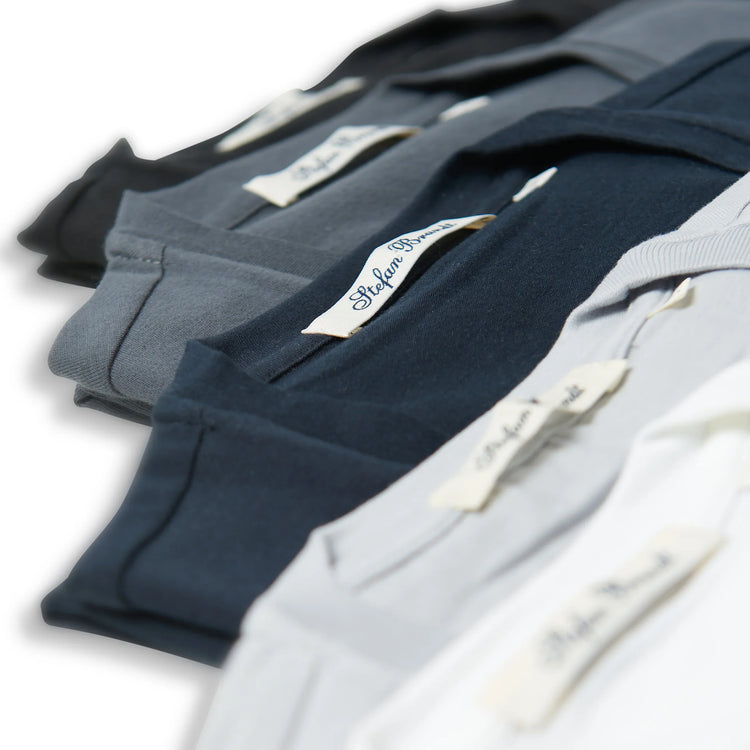
Stylistically, the Stefan Brandt T-shirt is a tool of understated elegance. White and black are its defining palette. Navy, ivory, powder, and stone tones are the subtle nuances that, beneath a blazer, don't shout but rather soften. In a world where T-shirts are often nothing more than mere canvases, Brandt feels like a return to the original: a shirt that doesn't need to communicate "loudly" because its feel against the skin speaks volumes.
Stefan Brandt Fashion
Here, "fashion" is less about trends and more about material aesthetics . When people talk about Stefan Brandt fashion , they're primarily referring to jersey in a depth rarely seen before: URPIMA SEA ISLAND® SELECTED as the core quality; ULTRA as an even silkier, cooling evolution; SUPER 100E as a highly compressed, elastic material for jackets or trousers; and French terry interpretations in linen and pure merino wool that balance moisture, temperature, and comfort like a well-tuned piano. Even ultra-fine 16-micron merino jersey appears – machine washable and tumble dryer safe – demonstrating just how far the concept of "refined yet practical" can be taken.
The brand narrative remains grounded: no overindulgence in fashion jargon, but rather comprehensible process innovation . Selective harvesting (unripe/overripe fruit is left on the bush), precise processes from raw material to finished fabric, then pre-treatment – step by step, losses factored in, quality gained. Nothing is romanticized here; instead, they explain why a color remains colorfast , why a fabric is naturally elastic without elastane, and why all of this is dryer-safe . For allergy sufferers, this sounds like music; for purists, it's logic.
The tailoring language used in jersey is equally distinctive: pick-stitching (decorative stitches), hand-fixing of interfacings, template seams for symmetry, and mother-of-pearl buttons on stems. This meticulousness is familiar from bespoke tailoring – at Stefan Brandt Mode , it's applied to knit and jersey tops. The result is a seamless flow, evident when a polo collar doesn't "tip," a button placket hangs softly and precisely, and a jersey shirt suddenly looks as clean as if it were woven. And again: function follows form – not the other way around.
The brand itself clearly defines its perspective: physicist's mindset meets textile culture . The journey began in the 1990s; in 2012, Brandt cites a breakthrough in its processes; and in 2022, its own cotton cultivation in Ecuador complements the quality cycle. The fact that the history of the extra-long cotton fiber Gossypium barbadense stretches far back archaeologically on Ecuador's coast is presented by the brand as context – one can interpret this as the cultural geography of the fiber or as a statement: We work at the source. For the customer, this simply means: transparency, consistency, responsibility.
The external perception has also taken hold. In the international menswear press, Brandt's jersey is described as "silk-like, lighter, smoother"; the reports emphasize the scientific approach, the in-house production, and its suitability for sensitive skin. Not everyone appreciates the "luxe" look in a visible outfit – but almost everyone who tries it understands the quality at the latest "on the skin," as a base layer or under an open shirt collar. That's precisely where its modernity lies: luxury that doesn't pose, but performs.
Stefan Brandt Online Shop
The Stefan Brandt online shop feels like a stroll through a perfectly organized wardrobe. Men will find a clearly structured selection – T-shirts , long-sleeved shirts , polos , shirts , hoodies & jackets , sweaters , pants , and underwear . Women will find a mirror image with T-shirts/tops, long-sleeved shirts, polos, blouses, hoodies & jackets, sweaters, pants, dresses & skirts, and nightwear. Everything says: less noise, more clarity. And yes: according to the shop, those who subscribe to the newsletter receive 20% off their first order – a rare bonus in this quality category.
What's immediately convincing online is the material transparency and the fit guides . You can find out which line has a lighter drape (50) and which a fuller fit (30), which men's T-shirts are intentionally cut slimmer , and how Prefit ensures colorfastness, elasticity, and suitability for tumble drying . This specific information saves on returns and provides peace of mind – especially if you're between sizes or planning to wear a style as an undershirt. The result: you don't choose "blindly," but consciously – whether as a standalone T-shirt with chinos or as a light layer under a soft knit.
A second advantage is the wide range of qualities available in the shop: from URPIMA SEA ISLAND® SELECTED to ULTRA , from French terry interpretations in linen/wool to 16-micron merino – the assortment reflects the company's innovation agenda. Those who delve deeper can read about the quality benefits at their leisure: GOTS- and bluesign-certified auxiliary materials, Prefit as a 15-step process, dimensional stability and colorfastness even at high temperatures. These are not marketing slogans, but verifiable claims that the brand publicly documents.
In addition, the service is thoughtfully designed: payment and shipping are clearly explained, and a store locator shows which premium retailers carry the product – helpful if you want to feel a model in person or are waiting for a specific color. The digital journey is short, yet the depth of information is surprisingly extensive. This is how an online shop in the quiet luxury segment should function: as a knowledge and quality interface, not as a noisy sales floor.
Anyone wanting to understand the pricing logic can check out specific products in the shop. For example, ELI SEA ISLAND I100 with 100% URPIMA SEA ISLAND® (160 g/m²) costs €179 . There are also alternatives – such as "SUPER 60" (mercerized, 170 g/m²) or "FG/Flammgarn" – each adding a subtle nuance in feel and appearance without compromising the core characteristics. The selection encourages a modular approach: a lighter T-shirt as an undershirt, a heavier one as a standalone piece – both united by the same core standard.
Stefan Brandt Sale
For Stefan Brandt, "sale" doesn't mean clearance sales. It means a limited time . Anyone familiar with the brand knows that genuine price advantages are usually short-lived and focused – whether through their own communications (newsletter promotions, 20% off first orders ) or via select retailers offering seasonal discounts. The pattern: older color shades, remaining sizes, and occasionally individual lines to make room for new arrivals. Patience and timing pay off, without compromising the core principle: materials and craftsmanship remain untouched.
Internationally, final sale phases can be found at retailers like Akrikks (USA), while some department stores in Europe also hold temporary sales. In short, the Stefan Brandt sale isn't a big spectacle, but rather a planned break in the cycle of a long-lasting collection – a chance for those in the know to snag a favorite color or a backup shirt at a better price.
Here's a practical approach: Opt for core colors (white, black, navy) because these offer the greatest versatility – under blazers, with denim, with flannel. Consider the weights (30 vs. 50) and decide what role the shirt will play: as an undershirt? on its own? Layered? Pay attention to size consistency : If you already wear an ENNO 30 in size M , you can hunt for the perfect piece in the sale without the risk of buying the wrong thing. And if a rare shade appears – say a muted "Bone" or a deep "Forest" – grab it. At Brandt, colors are curated , not arbitrary. This ensures that even a sale find remains compatible with a wardrobe designed for longevity .
And if you're unsure: A look at the store locator shows you brick-and-mortar partners where you can actually try out sizes, colors, and handles – so you know which models are worth buying as "sale anchors." In short, the Stefan Brandt sale is the disciplined way to save: never on the wrong thing, always at the right time.
Stefan Brandt Men
For men, Stefan Brandt is an invitation to think of their wardrobe like a portfolio : a few, highly functional pieces that add a touch of understated luxury to everyday life. The modular system begins with three pillars:
1) The basic T-shirt. An ENNO in Anexo 30 as a standalone piece, an ELI in Anexo 50 as an underlayer – both in white and black . This combination covers 80% of situations: from an early flight in a bomber jacket to dinner under a jersey shirt. If you choose a third color, go for navy : formal enough for a knit blazer, casual enough for denim. The fabric weights are clearly explained in the shop; if you want a more fitted silhouette, note that the 50s weights are slimmer for men.
2) The Jersey Shirt & Polo. Here, the brand's tailoring language is most evident. A jersey shirt with hand-fixed interlinings lies softly against the neck, the button placket remains uncluttered, and mother-of-pearl buttons sit securely on their stems. For days when a classic shirt seems too formal, Brandt offers the cleanest alternative – with the comfort of a knit and the overall look of a woven shirt. This logic is carried over to the polo shirt : a collar that stands up without stiffening; a placket that doesn't pull. The result is a sporty piece that can be worn with a blazer .
3) Layers & Leisure. French terry in linen (summer) or wool (transitional/winter) isn't just a hoodie cliché at Brandt, but a microclimate : The looped structure inside regulates moisture and temperature, traps air, and creates that typical, dry warmth that never clings. A 16-micron merino jersey underneath – machine washable and tumble dryer safe – suddenly transforms "casual" into city-ready .
When it comes to care , men can be pragmatic here: According to the brand, the fabrics are dryer-safe , colorfast , and retain their shape because the pre-fabricating process anticipates the fabric's "biography" and reduces tension. This means fewer surprises after washing, less pilling, and less loss of shape. For frequent travelers, this is a game-changer – shirts that can go in the dryer in the evening and fit perfectly again in the morning aren't a marketing gimmick, but the norm for this line.
The brand remains consistent in its pricing and retailer profile: premium retailers carry the merchandise, T-shirts in Europe are often priced between €139 and €195 , while international boutiques sometimes charge higher prices. Benchmarking is worthwhile: those seeking Sea Island quality and meticulous handcraftsmanship will quickly recognize that Brandt delivers a rare combination of sensuality and systematic approach . Men's wardrobes benefit doubly from this – in everyday life (comfort, care, durability) and in appearance (understated elegance, matte finish, and effortless style).
FAQ about Stefan Brandt
Where does Stefan Brandt's cotton come from?
According to the brand, they process selected bales of Peruvian ELS Pima cotton and have also been cultivating their own Gossypium barbadense stocks in Ecuador since 2022 – as a building block of vertical quality control.
What does URPIMA SEA ISLAND® mean?
URPIMA is a Brandt proprietary name for selected Pima bales and process standards; in this context, “Sea Island” refers to extremely fine, long fibers within the Barbadense family, which Brandt brings to a silk-like feel using its own processes.
Are the shirts really suitable for tumble drying?
Yes – according to the brand, this is a result of the 15-step Prefit treatment. Colorfastness, dimensional stability, and suitability for tumble drying are among the documented properties.
What is the difference between "30" and "50" on T-shirts?
"50" is lighter, silkier, and has a slimmer cut for men; "30" feels slightly denser and has a calmer visual appearance. Both remain soft and drape beautifully.
What price range is realistic?
For T-shirts, the price range in European stores usually extends from approximately €139 to €195 ; specialty items and international boutiques are sometimes more expensive. In the official shop, an ELI SEA ISLAND I100 costs around €179 .